Top 5 Gold Mutual Funds in India
Top 5 Gold Mutual Funds in India 2025: Best Picks & Comparison
Gold mutual funds have become one of India’s most trusted investment options for those seeking safety and steady returns without buying physical gold. These funds invest primarily in gold Exchange Traded Funds (ETFs) and mirror the domestic gold price movements, making them ideal for investors who want to benefit from gold’s long-term growth potential.
As of 2025, some of the best-performing gold mutual funds in India include Nippon India Gold Savings Fund, HDFC Gold Fund, SBI Gold Fund, Axis Gold Fund, and Kotak Gold Fund. Each of these has consistently delivered competitive returns, low tracking error, and easy liquidity compared to buying physical gold.
In this guide, we’ll compare the top 5 gold mutual funds in India based on 3-year and 5-year returns, expense ratio, fund size, and risk profile, and also help you understand how they differ from Gold ETFs and physical gold investments.
Highlights
Best Overall Performer (3-Year Returns): Nippon India Gold Savings Fund
Lowest Expense Ratio: Axis Gold Fund
Best 5-Year Consistency: HDFC Gold Fund
Most Balanced Risk Profile: SBI Gold Fund
Best for Long-Term Wealth Preservation: Kotak Gold Fund
All these funds invest in gold ETFs and aim to track the price of physical gold without the hassle of storage or making charges. This makes them ideal for long-term investors, diversifiers, and first-time gold investors alike.
Our Top 5 Gold Mutual Funds in India
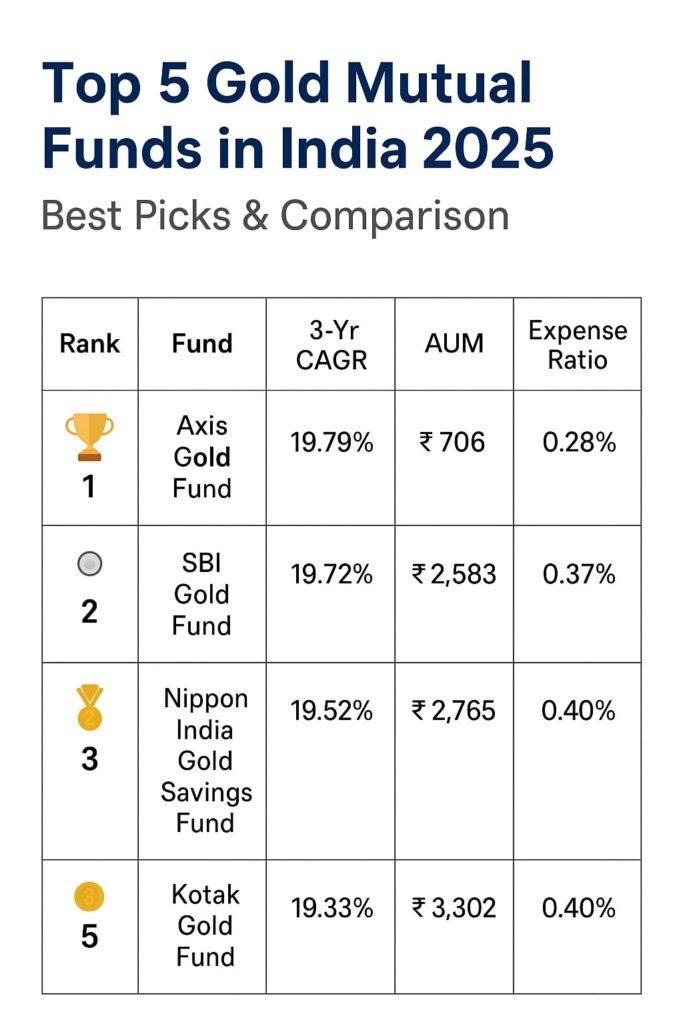
Below are India’s top-performing gold mutual funds, ranked by 3-year CAGR returns, AUM (Assets Under Management), and expense ratios. These funds invest in Gold ETFs and offer exposure to the domestic gold price without owning physical gold.
1. Axis Gold Fund
Fund Type: Fund of Fund investing in Axis Gold ETF
3-Year CAGR: 19.79%
AUM: ₹706 crore
Expense Ratio: ~0.28% (one of the lowest)
Why It Stands Out:
Axis Gold Fund delivers high returns with one of the lowest expense ratios in its category. It’s a great choice for cost-conscious investors seeking efficient exposure to gold with strong ETF tracking.
2. SBI Gold Fund
Fund Type: Fund of Fund investing in SBI Gold ETF
3-Year CAGR: 19.79%
AUM: ₹2,583 crore
Expense Ratio: ~0.37%
Why It Stands Out:
SBI Gold Fund mirrors gold’s performance closely and has built investor trust over time. Its steady growth and large AUM make it ideal for those wanting stability and strong brand backing.
3. HDFC Gold Fund
Fund Type: Fund of Fund investing in HDFC Gold ETF
3-Year CAGR: 19.72%
AUM: ₹2,765 crore
Expense Ratio: ~0.40%
Why It Stands Out:
Managed by one of India’s most respected AMCs, this fund balances performance with reliability. It’s suited for investors who prefer a conservative yet consistent gold allocation in their portfolio.
4. Nippon India Gold Savings Fund
Fund Type: Open-ended Fund of Fund investing in Nippon India ETF Gold BeES
3-Year CAGR: 19.52%
AUM: ₹2,203 crore
Expense Ratio: ~0.36%
Why It Stands Out:
Nippon India Gold Savings Fund offers long-term consistency and liquidity. It’s ideal for SIP investors and those who want a low-tracking-error gold investment option.
5. Kotak Gold Fund
Fund Type: Fund of Fund investing in Kotak Gold ETF
3-Year CAGR: 19.33%
AUM: ₹3,302 crore
Expense Ratio: ~0.40%
Why It Stands Out:
Kotak Gold Fund boasts the highest AUM among top peers, reflecting strong investor confidence. It’s best suited for long-term wealth preservation and portfolio diversification.
How We Selected These Funds
At Money Matter, our selection of the Top 5 Gold Mutual Funds in India for 2025 is based on a combination of quantitative performance metrics and qualitative investment factors that reflect both short-term performance and long-term reliability.
Here’s what we analyzed before finalizing the list:
1. Historical Returns (CAGR Performance)
We compared the 3-year and 5-year Compound Annual Growth Rate (CAGR) of all gold mutual funds in India. Funds with a consistent CAGR above 18% and low volatility were shortlisted.
2. Assets Under Management (AUM)
A higher AUM generally indicates investor trust and fund stability. We prioritized funds managing over ₹500 crore, ensuring they have sufficient liquidity and professional management depth.
3. Expense Ratio
Since gold funds track the price of gold, minimizing costs is crucial. Funds with an expense ratio below 0.50% were preferred, as they offer better net returns to investors.
4. Fund Consistency and Risk Profile
We examined the rolling returns and standard deviation of returns to filter out funds with erratic performance. Consistency and lower downside risk were key factors in our selection.
5. Fund Manager Track Record
The experience and stability of fund managers play a vital role. We reviewed each fund house’s investment strategy, track record, and management tenure before including them.
6. Diversification and Liquidity
Funds that invest primarily in gold ETFs (rather than physical gold) were preferred for ease of redemption and better liquidity, especially during market fluctuations.
Why Invest in Gold Mutual Funds in 2025?
Gold has once again proven to be a safe-haven asset amid global economic uncertainty, market volatility, and rising inflation. In 2025, gold mutual funds are emerging as one of the smartest and most convenient ways to invest in the yellow metal — without worrying about purity, storage, or making charges.
Here’s why investing in gold mutual funds makes sense this year:
1. Hedge Against Inflation
Gold prices typically rise when inflation increases. By investing in gold mutual funds, you protect your portfolio’s purchasing power while earning inflation-beating returns.
2. Portfolio Diversification
Adding gold exposure helps balance risk in your portfolio. Since gold often moves inversely to equity markets, it provides stability during market downturns.
3. Strong 3-Year and 5-Year Returns
As of early 2025, most gold mutual funds have delivered 3-year CAGR returns around 19% — outperforming several debt instruments and even some equity funds during volatile phases.
4. No Hassle of Physical Gold
Unlike jewellery or coins, gold mutual funds offer digital exposure to gold prices without worrying about storage, purity, or insurance.
5. Easy SIP and Redemption Options
You can start investing with as little as ₹500 via SIPs and redeem units anytime, just like any mutual fund. This offers liquidity and flexibility unmatched by physical gold.
6. Backed by Professional Fund Management
Gold mutual funds are managed by top AMCs like HDFC, SBI, Axis, and Kotak — ensuring your money is handled with expertise and transparency.
Related Blog: Digital Gold vs Gold ETF
Benefits of Investing in Gold Mutual Funds
Gold mutual funds are becoming a preferred choice for Indian investors in 2025, thanks to their mix of safety, convenience, and consistent returns. Here’s why they stand out:
1. No Need for a Demat Account
Unlike Gold ETFs, you can start investing in gold mutual funds directly through your mutual fund app or platform.
➡️ This makes them ideal for beginners and non-technical investors who want easy access to gold without dealing with stock exchanges.
2. Systematic Investment Option (SIP)
You can start with as little as ₹500 per month through SIPs.
➡️ This allows you to average out market volatility and build wealth gradually — perfect for long-term investors who prefer disciplined investing.
3. Managed by Professional Fund Managers
Each gold mutual fund is actively managed by experts who monitor gold prices, inflation, and market demand.
➡️ Their expertise helps optimize returns and reduce risk, especially during volatile market phases.
4. No Storage or Purity Hassles
Physical gold involves risks like theft, storage costs, and purity concerns.
➡️ Gold mutual funds eliminate these issues entirely — your holdings are in digital form, backed by 99.5% pure gold (via ETFs).
5. Easy Liquidity
Gold mutual funds can be redeemed anytime, just like any other mutual fund.
➡️ This gives investors quick access to funds during emergencies without worrying about finding a buyer, as in the case of physical gold.
6. Ideal Portfolio Diversification
Gold has a negative correlation with equity markets — it often performs well when stocks decline.
➡️ Adding gold mutual funds to your portfolio helps reduce volatility and balance risk during economic uncertainty.
7. Transparent Returns and Performance Tracking
You can track NAVs daily and check fund performance on platforms like Groww, MoneyControl, or Value Research.
➡️ This transparency helps you stay informed and make data-driven investment decisions.
Related Blog: How to Invest in Gold ETF
Things to Consider Before Investing in Gold Mutual Funds
While gold mutual funds offer multiple advantages, it’s equally important to understand their limitations, risks, and taxation rules before investing. Knowing these factors helps you make informed and realistic investment decisions.
1. Returns Are Linked to Gold Prices
Gold mutual fund returns depend entirely on international gold prices and the Indian rupee’s value against the dollar.
➡️ When gold prices dip or the rupee strengthens, the fund’s returns may fall. So, treat gold funds as a stability asset, not a high-growth option.
2. No Dividend or Interest Income
Unlike stocks or debt funds, gold doesn’t generate dividends or interest.
➡️ Your profits only come from capital appreciation — i.e., when gold prices rise. This means gold mutual funds are best suited for wealth preservation, not income generation.
3. Short-Term Volatility
Gold prices can fluctuate sharply in the short term due to global inflation, interest rates, and geopolitical tensions.
➡️ To benefit, consider a minimum holding period of 3–5 years for stable, inflation-beating returns.
4. Taxation Rules
Gold mutual funds are taxed like debt mutual funds under the new rules (post-April 2023):
Short-Term Capital Gains (STCG): Added to your income if held for less than 3 years and taxed as per your income slab.
Long-Term Capital Gains (LTCG): If held for 3 years or more, taxed at 20% with indexation benefit.
➡️ Always calculate post-tax returns when comparing with other investments like fixed deposits or equity funds.
5. Expense Ratio
Gold mutual funds have a slightly higher expense ratio (0.5–1%) compared to Gold ETFs.
➡️ This is because they involve active fund management and ETF purchase costs, but it’s a fair trade-off for investors without a Demat account.
6. Not a Substitute for Core Equity or Debt Investments
Gold funds act as a hedging tool, not a primary investment vehicle.
➡️ Ideally, they should form 5–10% of your total portfolio, helping protect against inflation or equity market downturns.
Need Expert Guidance