
Best Performing PMS in India (2025 Performance Review)
Portfolio Management Services (PMS) in India have gained strong traction among investors looking for active equity management, concentrated portfolios, and higher return potential compared to traditional mutual funds. PMS portfolios are managed by professional fund managers and offer a more customized investment approach, especially suited for investors with larger ticket sizes.
In this 2025 performance review, we analyze the best performing PMS portfolios across Large Cap and Multi Cap categories, using verified performance data that includes:
1 Month to 10 Year Returns
AUM (Assets Under Management)
Since Inception CAGR
Market Allocation Across Large, Mid & Small Cap Segments
This comparison highlights which PMS strategies have consistently outperformed, how they allocate capital across market segments, and what distinguishes top-performing portfolios from the rest.
The goal is to provide a clear, data-backed view of which PMS funds are delivering superior risk-adjusted returns in 2025, helping investors make more informed decisions.
What is Portfolio Management Services (PMS) and How It Differs from Mutual Funds
Portfolio Management Services (PMS) refers to professionally managed investment portfolios, where a dedicated fund manager constructs and manages a customized basket of securities on behalf of investors. Unlike mutual funds, where investors own units of a pooled fund, PMS investors own the securities directly in their Demat account. This gives PMS portfolios greater flexibility, transparency, and the ability to align the portfolio with the investor’s financial goals, investment horizon, and risk tolerance.
How PMS Works
When an investor opts for PMS, the fund manager:
Conducts research-driven stock selection,
Adjusts portfolio allocations based on market cycles,
Monitors performance continuously, and
Makes buy/sell decisions to optimize returns and control downside risk.
Many PMS strategies are theme-based or style-driven, such as:
Large Cap Stability Strategies
Multi Cap Growth Portfolios
Value vs. Contra Investing Styles
Small & Mid-Cap Alpha Generation Strategies
This style-based approach is one reason why performance varies significantly across PMS providers—making comparisons essential, which is where our data analysis becomes valuable.
PMS vs Mutual Funds: Key Differences
| Feature | PMS | Mutual Funds |
|---|---|---|
| Ownership | Investor holds stocks directly | Investor holds fund units |
| Customization | High (tailored portfolios possible) | Low (same portfolio for everyone) |
| Portfolio Concentration | More concentrated | More diversified |
| Minimum Investment | Typically ₹50 lakh+ | Starts as low as ₹100 |
| Transparency | Real-time visibility in Demat | NAV-based disclosure |
| Return Potential | Higher potential with higher risk | More stable, benchmark-linked |
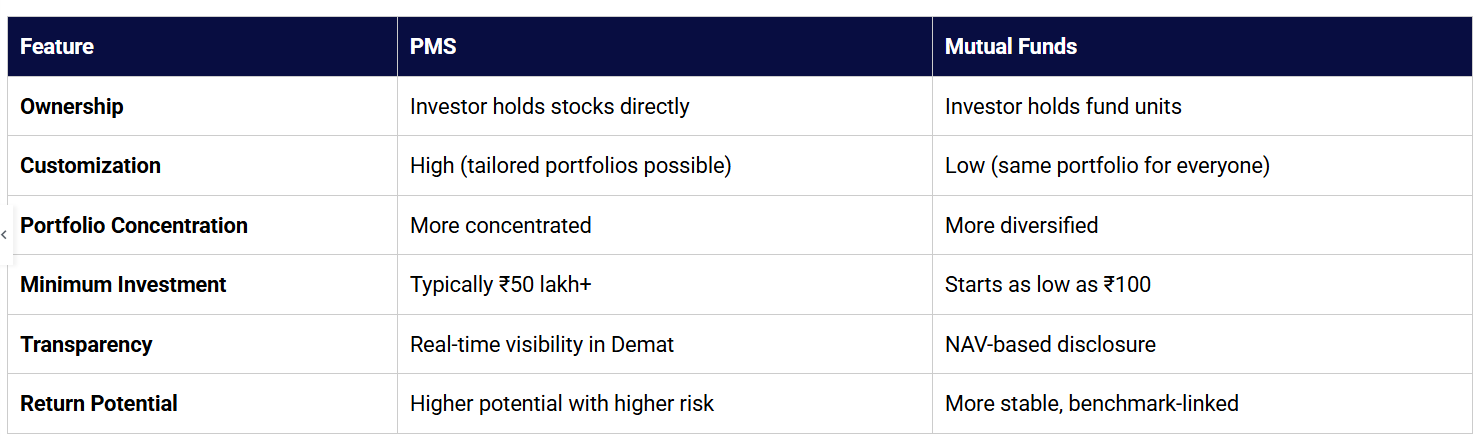
PMS vs Mutual Funds: Key Differences
Investors typically choose PMS for:
More active decision-making than mutual funds,
Higher return potential driven by concentrated conviction-based portfolios,
Direct exposure to equities with professional risk management,
Long-term compounding advantage in high-quality and growth-driven stocks.
However, PMS is not for every investor. Since portfolios can include mid and small-cap exposure, short-term volatility may be higher. The benefits of PMS are best realized when held with a 3–7 year investment horizon.
Why This PMS Performance Comparison Matters
Because performance varies by:
Market-cap allocation strategy (Large vs Multi Cap),
AUM and fund size,
Manager skill and conviction levels, and
Portfolio composition across sectors and stock styles.
That’s exactly why, in the next sections, we analyze:
Which Large Cap PMS are delivering stable long-term growth, and
Which Multi Cap PMS are generating the highest alpha (excess returns above benchmarks).
Best Performing Large Cap PMS in India (2025)
Large Cap PMS portfolios primarily invest in established, blue-chip companies with strong balance sheets and stable earnings outlook. These strategies are designed to deliver consistent long-term compounding with relatively lower volatility compared to mid and small-cap focused portfolios.
Below is a performance comparison of the leading Large Cap PMS strategies in India, based on 1-year to 5-year returns, AUM, and market allocation.
Performance Comparison of Top Large Cap PMS Funds
| PMS Strategy | Inception Date | AUM (₹ Cr) | 1Y Return | 3Y Return | 5Y Return | Since Inception (SI) | Large Cap Allocation |
|---|---|---|---|---|---|---|---|
| Ambit Coffee Can Portfolio | Mar 2017 | 1,256 | -0.4% | 11.6% | 15.3% | 14.6% | 75.5% |
| ICICI Prudential Largecap | Mar 2009 | 1,001 | -4.8% | 23.0% | 25.1% | 16.3% | 92.0% |
| Renaissance Opportunities Portfolio | Jan 2018 | 605 | -7.0% | 16.0% | 23.5% | 12.6% | 82.0% |


Key Insights
ICICI Prudential Largecap stands out as the strongest performer
25.1% CAGR over 5 years
23.0% CAGR over 3 years
Highest Large Cap exposure (92%), making it a pure play large-cap strategy
Strong long-term consistency, reflected in the 16.3% since inception return
Renaissance Opportunities Portfolio
Delivers a competitive 23.5% 5-year CAGR
Slightly more diversified with 82% large cap allocation
Ambit Coffee Can Portfolio
Known for quality and capital protection
Lower recent growth compared to peers (5Y CAGR 15.3%)
Higher mid-cap inclusion (lower large cap allocation at 75.5%)
Summary:
| Best for | PMS Strategy | Why |
|---|---|---|
| Stable & Long-Term Wealth Creation | ICICI Prudential Largecap | Strongest 5Y & 3Y performance + highest large cap allocation |
| Growth With Slight Aggression | Renaissance Opportunities | Higher return potential with some mid-cap exposure |
| Capital Protection Approach | Ambit Coffee Can Portfolio | Quality-focused but moderate return profile |
Best Performing Multi Cap PMS in India (2025)
Multi Cap PMS portfolios invest across large, mid, and small-cap companies, offering a balance of stability, growth momentum, and high-return potential. These portfolios typically aim to generate alpha (returns above benchmark indices) by identifying early-stage leaders in emerging sectors.
Below is a performance comparison of the top-performing Multi Cap PMS strategies, based on their 1Y, 3Y, 5Y returns, AUM, and portfolio allocation across market caps.
Performance Comparison of Multi Cap PMS Funds
| PMS Strategy | Inception Date | AUM (₹ Cr) | 1Y Return | 3Y Return | 5Y Return | Since Inception (SI) | Small Cap Allocation |
|---|---|---|---|---|---|---|---|
| UNIFI Blended PMS | 12-Jun-17 | 14,350 | -3.9% | 13.8% | 20.5% | 19.1% | 46.0% |
| ICICI Pru Contra Strategy | 14-Sep-18 | 12,110 | -3.1% | 23.4% | 27.5% | 19.6% | 20.1% |
| Abakkus All Cap PMS | 29-Oct-20 | 7,299 | -4.4% | 15.7% | 24.6% | 24.8% | 24.6% |
| Stallion Asset Core Fund | 22-Oct-18 | 6,177 | 4.7% | 38.1% | 32.6% | 29.8% | 20.7% |
| ValueQuest Platinum Portfolio | 24-Jul-14 | 3,273 | -12.5% | 20.8% | 28.6% | 18.4% | 58.3% |
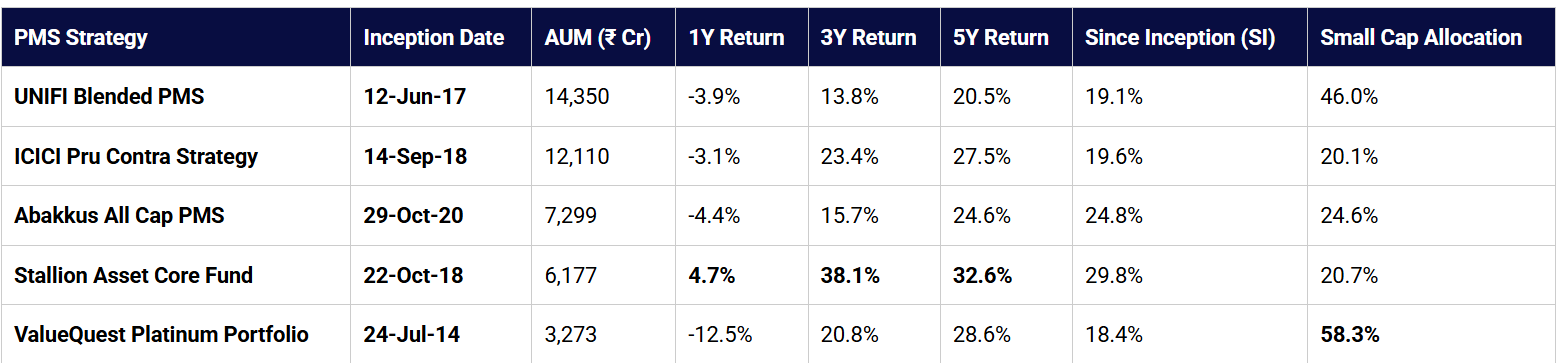
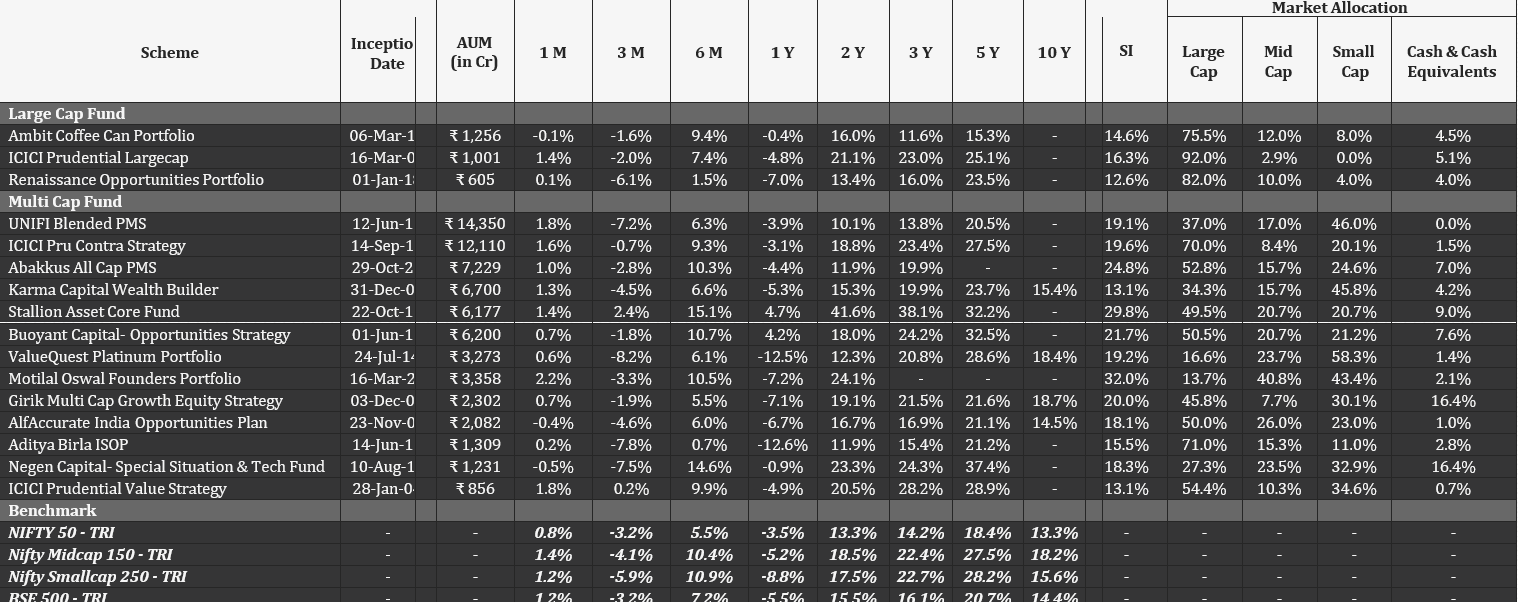
Key Insights
1. Stallion Asset Core Fund is the top performer over 5 years
32.6% 5-year CAGR — highest in the category
38.1% 3-year return shows strong mid-term consistency
Balanced small-cap exposure (~20.7%) helps manage volatility
Suitable for long-term aggressive wealth creation
2. ICICI Pru Contra Strategy shows strong risk-adjusted performance
27.5% 5-year CAGR
Maintains moderate small-cap exposure (20.1%)
Built on contrarian investing — buying high-potential businesses when they are undervalued
Best for investors seeking growth without heavy small-cap risk
3. ValueQuest Platinum & UNIFI Blended PMS lean heavily into small caps
ValueQuest → Highest small-cap allocation (58.3%)
UNIFI → High allocation at 46%
Higher return potential, but volatility may be higher in short-term market corrections
4. Abakkus All Cap PMS holds a balanced profile
24.6% 5-year CAGR
Consistent since inception returns (24.8%)
Ideal for investors seeking high conviction + diversified market-cap exposure
Summary:
| Investor Profile | Suitable PMS Strategy | Why |
|---|---|---|
| Aggressive growth, long-term horizon | Stallion Asset Core Fund | Highest 5Y & 3Y returns + momentum-based picks |
| Growth with controlled downside | ICICI Pru Contra Strategy | High returns with moderate small-cap exposure |
| High-risk, high-return small-cap exposure | ValueQuest Platinum / UNIFI Blended | High alpha potential but more volatility |
| Balanced, diversified approach | Abakkus All Cap PMS | Steady performance with broad market participation |
Market Allocation Trends in PMS Portfolios (2025)
One of the biggest factors influencing PMS performance is how the portfolio is allocated across Large Cap, Mid Cap, and Small Cap stocks. Each market segment behaves differently based on market cycles, liquidity, and earnings growth visibility:
Large Caps → Stability, lower volatility, steady compounding
Mid Caps → Growth potential with moderate volatility
Small Caps → Higher return potential but higher short-term fluctuations
The allocation data from the analyzed PMS portfolios reveals distinct investment styles across Large Cap and Multi Cap PMS strategies.
Large Cap PMS Allocation Style
| PMS Strategy | Large Cap (%) | Mid Cap (%) | Small Cap (%) | Cash (%) |
|---|---|---|---|---|
| ICICI Prudential Largecap | 92.0% | 3.0% | 0.0% | 5.0% |
| Renaissance Opportunities Portfolio | 82.0% | 14.0% | 0.0% | 4.0% |
| Ambit Coffee Can Portfolio | 75.5% | 19.5% | 0.0% | 5.0% |

Interpretation:
ICICI Prudential Largecap is a pure large-cap strategy, which is why it shows steady and consistent long-term returns.
Renaissance Opportunities and Ambit Coffee Can include more mid-cap exposure, which may increase growth potential, but can also lead to short-term fluctuations depending on market conditions.
Multi Cap PMS Allocation Style
| PMS Strategy | Large Cap (%) | Mid Cap (%) | Small Cap (%) | Cash (%) |
|---|---|---|---|---|
| UNIFI Blended PMS | 37.0% | 17.0% | 46.0% | 0.0% |
| ICICI Pru Contra Strategy | 70.0% | 8.4% | 20.1% | 1.5% |
| Abakkus All Cap PMS | 52.8% | 15.7% | 24.6% | 7.0% |
| Stallion Asset Core Fund | 49.5% | 20.7% | 20.7% | 9.0% |
| ValueQuest Platinum Portfolio | 16.6% | 23.7% | 58.3% | 1.4% |
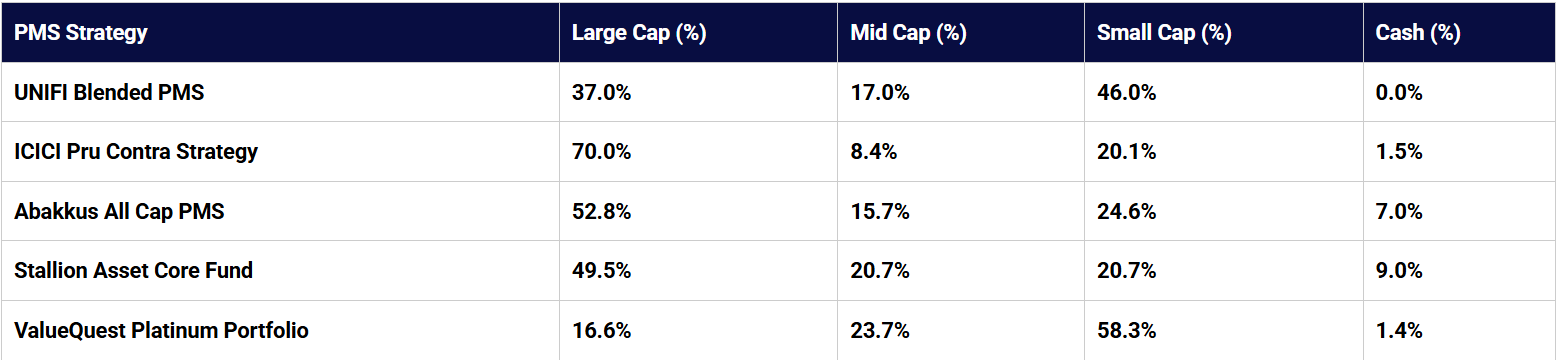
Interpretation:
Funds like ValueQuest Platinum (58.3%) and UNIFI Blended (46%) have high small-cap exposure, driving strong long-term returns but also higher volatility.
Stallion Asset Core and ICICI Pru Contra maintain balanced small-cap exposure (~20%), resulting in high, but more controlled growth.
Abakkus All Cap holds a balanced spread across caps, explaining its steady, high-quality return trajectory.
Conclusion — Choosing the Right PMS in 2025
The data shows that PMS portfolios continue to outperform benchmarks over the long term, especially in multi cap strategies where fund managers have more flexibility to capture growth opportunities.
If you prefer stable and consistent compounding, a Large Cap PMS like ICICI Prudential Largecap is a strong choice.
If you want higher growth potential and are comfortable with some volatility, Multi Cap PMS options such as ICICI Pru Contra and Abakkus All Cap offer well-balanced exposure.
For aggressive, high-return seekers, strategies with higher small-cap allocation like Stallion Asset Core and ValueQuest Platinum offer strong alpha, but require patience and a longer time horizon.
In short:
Choose your PMS based on your risk appetite, not just returns — and stay invested long enough to allow compounding to work.
Need Expert Guidance